Sunday, February 11, 2024

02.11.24 Wait, is this stuff top secret?...


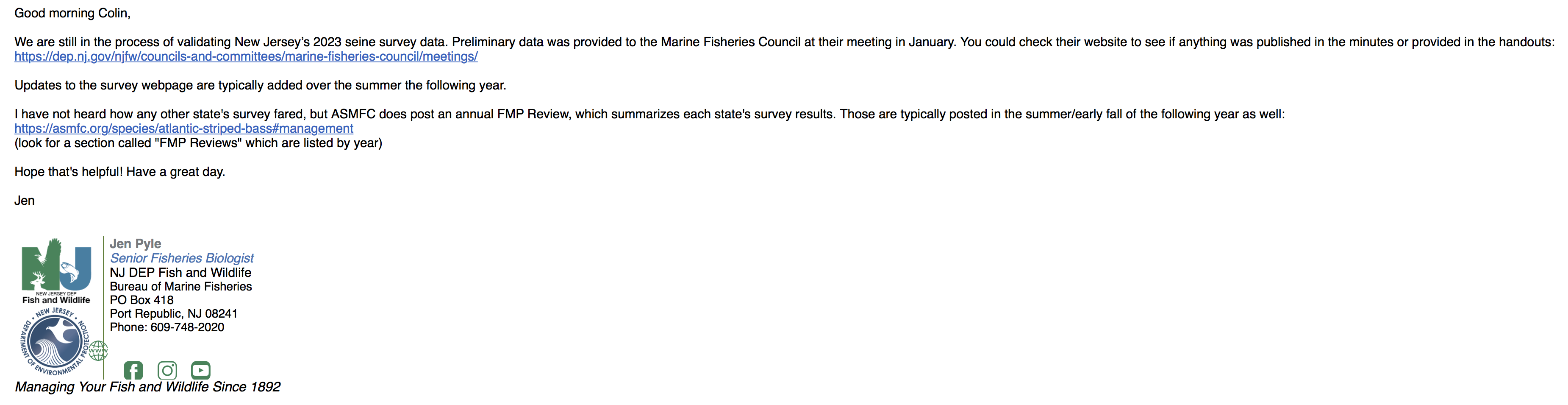
         I was scratching my head just a bit as I read the reply from the NJ DEP's senior fisheries biologist the other day. I had dropped her a note asking where I could see the results of New Jersey's annual Delaware River striped bass seine survey. Sounded easy enough of a request to me. (Click to enlarge)

     The stock status of striped bass along the east coast is assessed and managed under Amendment 7 of the Interstate Fisheries Management Plan, or FMP. That's all ASMFC stuff. Several states with spawning rivers complete annual surveys and arrive at a spawning striped bass number or YOY index, which in part goes into determining the health of the striped bass. People wait with baited breath for the results to come out. Rivers that are surveyed are the Chesapeake, done by different states like Maryland and Virginia, the Hudson, which is done and falls entirely in New York, the Roanoke River done by the N.C. Wildlife Resources Commission, and there's the Delaware River, which is near and dear to my house and heart. 

     The Delaware River gets surveyed by the NJ DEP, PA Boat and Fish Commission, and Delaware's DNREC. Now Pennsy's and Delaware's survey looks for spawning striped bass rather than the YOY, or fish less than one year old. 

     I have witnessed the PA scientists electrofishing the Delaware River over the years. They shock em, measure them, and tag them. They're looking for spawning aged striped bass. They also monitor the tag returns after these fish are caught. It's always interesting to see where a fish, caught 

and tagged in say Bordentown, NJ, winds up after making their way back out into the ocean. You can see above where they have been caught from 1995-2022. But let's head back to New Jersey.

     So what I was searching for was a simple chart or website that I could go to to get the data from the New Jersey seine survey YOY results over the last 42 years. Now, interestingly, people challenge the science, always. And what is science? What is data? How are the results arrived at? Just step into a ASMFC or any fisheries management meeting and you'll see you need a doctorate degree in statistics to figure it out. For my brain, and the way I teach at the college level is this, K.I.S.S., or Keep It Simple Stupid. I don't care if it's interpreting EKG's (toon fast or too slow), DKA, or diabetic ketoacidosis (blood sugars to high, or in general they could be to low), or the effects of left sided heart failure which could include pulmonary edema, (too much or too little fluid). You have to approach things at a basic crawl-before-you-walk mentality so you can understand them. 

     So to me it would simple. Any said year had a, say 1.06 number, and the next year a 2.4 number, maybe meaning things are looking better. Any less would be bad, especially if it was below some trigger level number. Triggers are put in place so that below a trigger level, something has to be done. I expected to be provided, or directed to, some place where I could see the 42 years of data. 

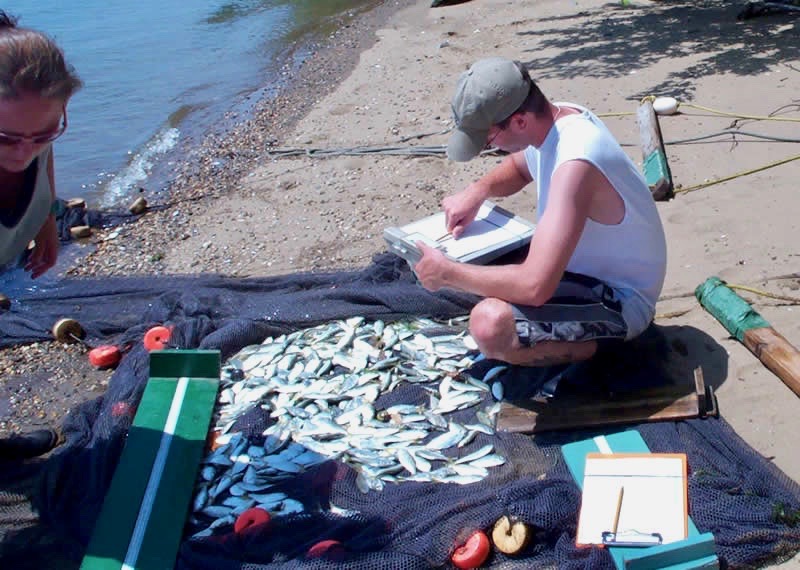
    Let's look below at the 2014 seine survey. So, these surveys aren't all about the striped bass. They say it's the primary target species, but really it's a throw out the net and count everything that you catch survey. It is then listed by abundance, with some mention of the striped bass YOY geometric mean, sometimes, in some random years. 


     So in 2014 2,135 striped bass were caught, and 2,070 were YOY, less than a year old. So, on that day, in that year, 97% were YOY, but no YOY index (geometric mean) was reported. There should be an easy chart showing that from year to year, but in the report for 2014 all we see is that listing of striped bass at 4.726%, the percentage that striped bass 


made of the total haul. What does that tell me? Is that science? A few scientists, interns, and kids dragging a seine net on a clear day and counting fish as they flip around on the sand. Mmmmm. I hate to be an anti-guy, but, c'mon man. 


   In the reply email Ms. Pyle explained to me that while the seine survey has been completed in each of the last 42 years, except 2020 due to Covid, and that data is only available from 2009 until present. What? What does that mean? She states they didn't start "posted annual updates until 2009, so there aren't any missing, they just don't exist". So wait. There's not a guy or girl that is so jazzed up about striped bass that they don't have one YOY number, or even those abundance numbers, from each of the 42 seine survey results somewhere in some office? In the basement? In a file cabinet? Can I go and look for them? 

     And then it just got weird. If I want information, simple numbers, I would have to "complete a data request form" to the Bureau of Marine Fisheries for approval. This isn't body-cam footage of a police officer involved shooting I'm looking for. She goes on further to explain that, "This just keeps us in the 


know of what people are doing with our data". Wait, "our data". Isn't this public knowledge kind of stuff. Like how many fish were in the net? If someone who questions the science, and the data, and government organizations, saw this post they'd have a stroke. Now I not suggesting any Tom-Foolery going on. I'm not picking on the NJ DEP or Ms. Pyle, but..... really? 

     Looking at the results of Delaware River striped bass YOY results from before the moratorium in the early 1980's until now would be interesting. I love striped bass. I love the Delaware River. When people tell me that's all they think about, like striped bass fishing and stuff, I say, no, you don't, I do. I think about them and all things related to striped bass all day, everyday, while awake and when I'm asleep. You may go and fish and catch when their around and post on your social media account, but are you really that into striped bass? Hey, to each their own, and I am not suggesting that my OCD of all this is in any way normal. For some it's just fishing, which is great, but then there's nutty folks like me. 


     So while you're waiting for March 1st to arrive, and maybe you'll even catch a fish on opening day, I'll be waiting for my FOIA (Freedom of Information Act) request on how many striped bass that 20 year-old Stockton University Marine Biology major counted on the sands of Salem County while he thought about lunch at the WaWa around the corner. 

     "Science doesn't lie", they say. Okay, but something has to be done in a uniformed manner across the board, for all of the states, that create "the science". If striped bass, in my opinion, are changing the rules of engagement, by adapting or maladapting, due to several factors, then the science, and how we go about collecting, analyzing, and publishing results has to change with it. Otherwise, the sides can use that data and published results to strengthen their positions or arguments for their own gains, not for the best interest of the striped bass. 

Saturday, February 10, 2024

02.10.24 Thank God it went down this way...


      This is the story of an old, well older man, an older boat, and a younger guy with a mental disorder. It was December when I went over to Joe's house and asked, "Hey, Joe what are you going to do with that boat?". "Scrappin' it", he answered. But, to me, it was an opportunity to give life back to this "sweet" 


18 foot aluminum boat. It could be like an old Cartoppers boat they used to launch off the beaches in Monmouth County. Or I could re-do the transom and throw on a small engine to putt around the bays. If it were up to my Sandford and Sons ass that thing would be parked in, what my wife calls, my tobacco road yard, where it would have sat for years. Luckily Joe talked some sense into me and luckily I found my new love just days later on Facebook Marketplace. 


    So thankfully that is what took me out out my delusional state and I relented to the idea that it's worth is far more in it's salvaged value than back on the water, like it would ever got there. 


    Joe was ready to let go of the bigger boat, but his love is the 1970 war-wagon that sat alongside the other. "Do you know how many striped bass I caught in this thing?" Off the back is a 1970 Evinrude 


that just needs "a thing or two" to get it back into service. One day this year him and I will take this fishing vessel out to recreate history. I will be sure to wear my life jacket and have a charged cell phone in my pocket.


     So yesterday was the day to say good-bye and get a couple shekels for it's value in the aluminum. We pulled in to the metal recycling yard and the crew made quick work of unloading it with a forklift. Joe watched through an open door as the boat left the trailer. 

    There are thousands of gently and beat up used boats that sit in boat shop yards, boat yards, and back yards that just wait for a rebirth or to meet their fate at the salvage yard or dump. At one point these boats were new, the owners younger, and ready to help create lasting memories and stories of the big one that got away. 


Friday, February 9, 2024

02.09.24 A great loss for Barry Beck and the fly fishing world...

Beck- Edison 2011

     If you don't know the names Barry and Cathy Beck you haven't been paying attention. This dynamic duo have been in this game for decades and were pioneers in all things fly fishing and photography. Many, many, many of the big fly fishing journals, when we had many, used to use their images almost monthly. If it wasn't images for a feature story it was their stock images used for art, or advertising, or for manufacture's catalogues. 

     I had my first contact with Cathy when I wrote to her in March of 2010 looking for some help with the business end of fly fishing photography. You see, once upon a time, photography was an art form, that was property, and had real value. The picture sold the copy. And those were the days when magazines and newspapers used to send you on an assignment. Go shoot this, get these shots, here's what it'll pay. Now, it's, "Hey Colin do you have any images of fly fishing the Upper Delaware?"Really bro? And then I'll spend 40 hours pouring through the hard drives, make them low-res, send them, and then get the email, "Okay great, thanks, we'll let you know". 

     So, as I tried to merge my photojournalism background with fly fishing I reached out to the giants, and they got back to me after they returned from their beloved Argentina. She was always ready to stop and help anyone who needed it, even me. So, it's a little long, you can scroll through if you like. 

__________________     

-------- Original Message --------

Subject: 

Colin- HELP!! with an industry question

Date: 

Fri, 26 Mar 2010 15:37:35 -0400 (EDT)

From: 

colin@theaverageangler.com

To: 

info@barryand cathybeck.com


Hi Cathy-


   My name is Colin Archer and I am a big fan and professional photographer in New Jersey. My agency, www.agencynewjersey.com, contracts primarily editorial work to magazines and what's left of the bigger newspapers. I have been fly fishing for twenty years and have slowly merged my passions for both at The Average Angler, theaverageangler.com. I have done a few articles for newspapers and fly-fishing magazines with a New Jersey based writer. It's always fun to do, but not good business, and here is where I am asking for a little advice and guidance. 

   I have run my photography business as a business. No spec work-unless for stock, contracts for everything, use rights clauses, chain of possession letters if the images are sent around their office, and get paid for everything. When I contact fly fishing editors and mention what my workflow is it's seems they get offended and are quickly not interested. One of my biggest sticking points is having images posted on an archive provider, Photoshelter, where an editor can edit and download right from there. That gives me an opportunity to show more and have them available for other uses. It is similar to sending a contact sheet back in the day. They would make selects and then we would make up prints.

    Most magazines, have a "Send us all the high res tiff's and RAW files and we'll let you know." Always nice about it- but what journalist or artist would just send their work to someone, somewhere? And without a contract or anything in writing? 

    When the technological boom hit and killed photojournalism as we knew it, we as shooters had to learn to say "No", usually after giving away the farm during the learning curve. The newspapers "free" websites are now learning those lessons as they try and find a way to get people to now pay for content ( Example- One of our clients-The New York Times) . So now, it seems, I say no more than yes, and have to fight for what my industry says it right. Not to only to protect me and my business, but also the shooter next to me, or the one coming behind me. 

     As far as the money. Years ago, I know that was then, a magazine would commission an assignment. Expenses plus the day rates, plus something extra for a bag of chips. Now the monies they offer don't cover the gas. It seems to be a world of enthusiasts, hobbyists, and guides with cameras who make and share, provide or maybe even sell images as an aside. I know it is what it is. I can't tell you how many reader submitted pictures I see in The New York Times and even in National Geographic. 

     So, after all that I would like any advice you may have for a photographer making first contacts with the magazines, or now fly-fishing websites. I was recently in contact with an editor who asked me to send 5-6 Tiff's to be one of a group of featured photographers on a fly-fishing website- with no compensation. Moreso, where do all those files we submit to these magazines and fly fishing websites wind up? How are these photographers and writers paying the mortgage and sending their kids to college if pictures and stories have no cash value? Because we've already given away the farm? The promise of links, friends, and contacts- don't work when the bills are due.

    I look at the advertising rates in all the magazines, and those ads are sold because of great images and stories- why do we take less than what the industry says we should? We as photographers, look to shooters like John Harrington for industry advise when it comes to treating photography as a business. I just don't see those principles used in outdoor magazines. 


I want to do the right thing; I just don't know what that is anymore.


Thanks for any thoughts you have on this, and have a safe and prosperous year,


Sincerely and respectfully,


Colin Archer

www.theaverageangler.com

732.261.7291


__________


     On 3/29/10 9:32 AM, info@barryandcathybeck.com wrote:


 From: Cathy Beck <cathy@barryandcathybeck.com>

Subject: Colin- HELP!! with an industry question

Date: April 1, 2010 at 11:34:08 AM EDT

To: colin@theaverageangler.com


Colin,


Your email arrived while we were in Argentina, so first of all, our apologies for not getting back to you sooner. All of your concerns are legitimate and of growing concern to all of us. The media world is changing fast and I'm not sure anyone has the answers figured out. For us, there are no industry guidelines. Photographers in our business have tried that and it doesn't work. We work with each client on an individual basis. The bigger clients have a better budget than the smaller ones but at the end of the day sometimes the work that goes out to the smaller ones balances out the fewer sales that we may get from our bigger clients. It's very time consuming and labor intensive, but we have to make payroll, pay the bills, and put food on our table. We don't turn anyone away. 


Our submissions are all jpegs and once the client makes the selection, we send the hi res - usually downloaded to an ftp site. We try to watermark as much as we can but a lot of the time we have to trust our clients with our images. Embedded in the metadata is the copyright. 


Although we don't have any answers, I hope this has helped. We'll be glad to correspond anytime, please don't hesitate to contact us again. 


Cathy Beck


-- 

Beck Photography

309 Upper Raven Creek Rd.

Benton, PA 17814

877-278-5638

570-925-2392


_________________


     I also had the pleasure of spending some time with Cathy after one of her woman's Fly Casting Classes at the old Somerset show. I enrolled my hopeful-to-be fly fishing partner and wife Theresa 


Student and teacher- 2017

into her class and they both had a great time. Theresa left their amazed on how good, and nice, Cathy was. And if you ever talked to Cathy, and Barry alike, both just made time stop when they were talking with you. 


     I stopped and said hello to Cathy at The Fly Fishing Show in Edison a few weeks ago. She was all smiles, as usual, and just doing her thing as she did every year that I can remember. One of them had penned a post on their blog January 25th, just a day before I would see her. 


     In that post you kinda get the vibe of just how grueling their schedule was, but they loved that New Jersey show. Before the show this year they were in Christmas Island and then when the show ended they were off to Argentina to host yet another guided trip. Below is a photo of Cathy during their recent, well current, trip to Laguna Verde. 


     The Beck's lived in Benton, Pennsylvania, but the entire world was their backyard. They had a grueling schedule, for decades, between doing all of the major shows, owning a fly shop, travel assignments, hosted trips, presentations, and fund raisers. They were a true industry power couple. And continued to be until two days ago when Cathy passed away while on that trip in Argentina. 


     Cathy was a pioneer in the fly fishing world, and undoubtedly one of the most influential women in fly fishing. She deservedly was admitted into the American Museum of Fly Fishing and Fly Fishing Hall of Fame and her legacy will live on forever. RIP Cathy Beck, February 7, 2024. 


Thursday, February 8, 2024

02.08.24 And the (new) Helios arrives...


     So if I'm thinking of switching things up why would I pimp out the new Orvis Helios rod? Well, first, I know this blog will generate at least 1,000 sales, no, just kidding. Why? Because I really enjoy watching the business end of the fly fishing and tying industry. It fascinates me when I'm not being fascinated about striped bass. In the end Orvis wins everytime someone talks, posts, or mentions the rod launch, even if it's negative, negative press moves the chains forward as well. 

    We are, well Orvis is, a day into the launch of the new Helios. Like I posted before the launch, this rod is all about accuracy, as per Orvis. Below is the video put out by Orvis and Shawn Combs, the Nasa-like engineer who is in charge of rod design. Here it is,


     From what I see online there are 29 different models of the rod, in length and line weight, that fall into a two versions, the D, for Distance and F, for Finesse. The claim by Orvis that this rod is even more accurate than the last most accurate rod in the Helios 3 can be illustrated below. 


     It's something called "wobble testing" which looks at rod tip movement throughout the cast, particularly as the plane comes in for the landing. Less tip wobble means more distance and more accuracy. Now Orvis designed the testing apparatus for the wobble testing and they are the ones who came up with the 4x more accurate than the Helios 3 and 16x more accurate than the competition. If you 


look above why not label "Top Competitor" with the actual name of the rival rod making company. If you have it like that, flaunt it. To me, it's kind of cowardly. If you're going to pick a bar fight, at least stick around and throw a punch when it all goes down, don't slip out the back door. If I were a rival company I'd be scrambling to find an independent tester to blow Orvis's self-generated claim up. It's kind of like me filling out a survey about myself as a teacher, a survey in which I put together, and then telling everyone I am better than the rest of some of my colleagues, without naming names. 


     The price tag for the D models is $1198, which is right where I thought it would be. Interestingly, the new line comes with rods in different lengths. While we've been programmed to that 9 foot length for years the idea of a 8.5 foot 10 wt intrigues me. The 14 weight comes in at that length as well. Designed more for the boater? It'd be interested to see how it casts, at least the 10, compared to the 9 foot H2. 


      Orvis Princeton, our lone shop in New Jersey, has them at the shop and they can be taken for a practice cast out back. Call the shop to see what models they have there. I haven't been over yet but hopefully in the next day or so I will be able to put one in my hand. I heard they sold a few of the new rods so it's off to the races for them. During the summer Orvis invited some of the big-gun magazines and blogs and influencers up to the Mother ship to introduce them to the new line, well, I didn't get that invite, so I know where I stand with Orvis. Maybe they think I couldn't be sworn to secrecy. 

    And on Facebook the fun begins. Hey, it's not the 4D, it's the Helios D or F, get that shit right!


Wednesday, February 7, 2024

02.07.24 I think the NJ DEP is a little slow on this one...


      I have been waiting to see the 2023 Delaware River Striped Bass Recruitment Seine Survey results for months now. Jim Hutchinson, of The Fisherman magazine, mentioned that the results were poor after his coverage of the NJ Marine Fisheries Council meeting in January. I guess the DEP sent over a teaser for that meeting, but I have not seen anything on it. 

     I decided to write Jen Pyle, the Senior Fisheries Biologist in New Jersey. The above was her reply. Click on it and it gets bigger. Now, is there a more hot topic out there than the striped bass now? Isn't the Delaware River one of the big three natal rivers? Haven't the Chesapeake and Hudson YOY reports already been published.....c'mon man, or woman. 

    Now we really haven't had good surveys over the last several years. 2002 was completed, and years 2020 and 2021 weren't done or were incomplete due to Covid. How does Covid affect people dragging nets along the river and counting fish? C, mon man, or woman. Below are the 2020 numbers,


    To not get stuck on the numbers, 2020 had an index of 1.029% (above). Just for comparison the chart below are the numbers from 2009, some 15 years ago. That showed a 4.194% return. We'll see what comes of 2023 when they get around to putting them out. And still now word from the Pennsy surveys. 

     The above numbers represent a % of the species collected, not necessarily a YOY geometric means. NJ may do it a bit different. An example, in 2019 there were 958 striped bass collected. Of that 841 were YOY, or less than 1 year old. The YOY index  (geometric mean) was 1.31, which ranks it 13th highest out of the 42 years they have been collected, they started in 1980. You can see below the 2019 seine 


survey results, which shows a "catch" of 3.575% striped bass, while the YOY index is 1.31, two totally different numbers that means two totally different things. 


Monday, February 5, 2024

02.05.24 Might be time for the big stick....


     Been kicking some things rod-wise around since last year. I've been an Orvis guy through and through for, say, 30 plus years. I have used their rods for as long as I can remember. From the starter line through the highest end they had at the time. I have used them personally and offered them to cleints when they were in my drift boat or my center console. I'd have to say my H2 10 and 11 weights have been my favorite. I skipped over the H3 and now just days away from the Helios launch I have some figuring out to do. 

     Most people in the know direct those just starting out to spend their money on a better reel than a better rod. If you can swing both then great, but not everyone has it like that. When the Helios drops there will be those anglers, and Orvis is counting on it, that will buy the new Helios just because a new rod came out, even though they have Helios 2's, 3's and more in the gun locker. That's great, to each his own. 

    Endorsed guides, pro-staffers, rarely use "exclusive" brands with their clients. They are Orvis Endorsed but wear Simms waders. Sage pro-staff but use Nautilus reels. A lot of pro-staffers are in it for the deal or the discount. That's why their arsenal is a combination of every manufacturer there is. For me, I'm all in, to a fault, because for a while there I was looking like I belonged in an Orvis catalogue. It's just the way it is and the manufacturers don't seem to mind nor police it. The more their product is out there the better. To me it would be like a guy from the Phillies wearing a Mets cap. 


     I've been back and forth on what my next big striped bass fly rod should be. My Orvis Clearwater 12 wt. has seen it's day. The butt is missing. It's been beat up. It has served me well. I have caught big, like some real big, fish on it. Over the years several of my friends have told me about Colton Fly. A local and single person owned company from Dingman's Ferry, Pennsylvania. The owner, Bob Filger, offers fly rods and reels from 4 through 17 weight. I have heard his reels are just about the best out there on the market. 

     Today was great day for a long ride to scout. I jumped in my buddies ride after dropping Lauren off at the Philadelphia airport and we were off. It's always nice to see new water with a different vibe. It's a big river and a big river means, well should, mean bigger gear if you are going to find and fish for big 


fish in big water. While some like to go down to lighter rods when there's nothing but small fish in front of them, fighting a big fish in big current really beats the fish up. And if you're under-gunned you may, or most likely, not even land the fish at all. You shouldn't bring a knife to a gun fight. In the end the bass suffers the most. 

     I'm an all or none type of guy. Pretty much fish for striped bass. Period. Alway's been an Orvis guy. Period. The thought of switching up and going with a new company for my rods and reels is a little indimidating. Of the 2,966 posts that I have wrote here I bet "Orvis" is mentioned in at least 40% of them. Who does that serve best? Maybe it's time to reconsider my one sided loyalty and go with a local guy, who's kinda under the radar, and offers a wide range of solid products that tackle both small and huge fish. 

Who knows. To each his own. But I better decide quick as we're only a few weeks away and I'd like to start the season with some new rods and reels in my hands.  

Saturday, February 3, 2024

02.03.24 An afternoon with the two Joe's....


      What a better way to spend a rainy day then down in Joe Armenti's fly tying room. Delaware Joe and I got over about 11 and soon it was just shooting the shit over a cup of coffee. Armenti let me browse around and through the drawers of his tying stations. Not only does he have a lot of materials, I mean a lot of materials, which are mostly mostly for trout flies, 


he also takes and fills orders year round. Next to his vice was an order for 11 dozen flies that to me just looked like they would be eaten no matter what hatch was going at the time. It was also a throw back 


to some materials from the past, like Big Fly Fiber and Gartside's Secret Stuff. Joe is very talented and that goes back to his days when he opened and owned a fly shop in Trenton, imagine that there these days. 


     As I looked through the bins I couldn't get over how much dubbing material he has. I mean he has tons of it, and not for no reason. Each color means something, and something specific to somewhere. There's colors for the Upper Delaware, or Catskills, for Central Pa., and for other bodies of water, where the color of the same fly might just be a shade or two off. He even gave me a demo on how he mixes 


dubbing creating that shade that is exactly, one, from the recipe book, or two, what his customers order. If you need trout flies, or materials, or dubbing blends, by the gallon, give Joe a call at 609 448 0062. 

     As I sat and listened I reached back into the library and picked out Saltwater Fly Patterns, a 1995 book written by Lefty Kreh. That book is nearly 30 years old. Pop Fleye's came out in 2001.


What struck me was the below note that Lefty wrote about Bob. Interestingly he wrote at the end, "I am sure by the time this is published several more ideas will have sprung from his fertile mind". The Collin's 


Dictionary defines fertile mind as, A fertile mind is able to produce a lot of good, original ideas. Well there you go. Maybe Lefty was onto something back in the mid-1990's. Bob was 47 years old at the time of Kreh's book. 

     It's really a hoot spending time with these guys who have been friends since they were about 12 years old. They have fished and hunted hundreds if not a thousand times together. They were at it this fall driving the beach in IBSP but I was never able to make the trip with them. Soon we'll be hitting The Shady Rest for some Trenton pie, a cold beer or two, and more good times. 


Friday, February 2, 2024

02.02.24 Is Delaware a snake in the grass?....


     Ah, Delaware. Isn't it your favorite state? To be honest I don't know much about Delaware at all. I know Joe Biden lives there, I know the Cape May-Lewes ferry goes back and forth there, and I know I have to cross through it on 95 heading points south from New Jersey. Oh, and I know they have a  New-ark and we have a Nork, both spelled Newark.  

     But I never really think of Delaware when it comes to striped bass. Are they just a bunch of under-the radar-snakes in the grass? When we think of spawning rivers the big three are, the Chesapeake Bay and it's tributaries, (Virginia and Maryland, and headwaters of the Nanticoke River in Delaware), the Hudson River (New York), and the Delaware River (mostly New Jersey and Pennsylvania). But alas.....Delaware is a huge player in Delaware River striped bass. 

     The Delaware Bay runs from Cape May to the north 17 miles to Cape Henlopen State Park to the south. Basically that's the cutoff between the ocean and bay and river fisheries. When they determined mile markers in the Delaware River Exit 0 or RM 0 starts at that imaginary line between N.J. and Delaware. To me the actual start, or mouth, of the Delaware River would be just west and north of the Delaware Bay, around Hope Creek or RM 48. The Delaware Bay is 785 square miles, for comparison, the Raritan Bay is 109 square miles. And remember the Chesapeake...4,479 sq. miles.

     So, when I think of the Delaware River I think of it more in terms of where I live and fish, around RM 140. It's New Jersey on one side and Pennsylvania on the other. Two states divided by water, each with their own set of striped bass regulations, like open seasons and size limits. As you go north it becomes Pennsylvania on one side and New York on the other. Going south it's Delaware on one side New Jersey on the other. 

     What separates the states is an imaginary line, kind of like the 3-mile EEZ, that runs down the middle of the river, maybe, because in some sections the split is in the middle of the channels. But again, different states with different rules. 

     Striped bass come into the Delaware River to spawn. There's a bunch of environmental stuff that has to happen to have a successful spawning year. But what we think we know is that the primary spawning ground for striped bass is between Marcus Hook, Pa. to the north RM 77 down to Wilmington De., RM 70. That's what the scientists say. To me, the true spawning locations are north of that. One of my life's goals is to photo/video them going at it in the Delaware. 

     So where am I going with this? Well, lets talk about and get rid of New Jersey. Ocean fishery, back bay and river fishery, Gamefish status with a Bonus Tag Program, done. Now, what about Delaware? Well, if we look across the pond from say Fortescue, those Delaware boys have a recreational and 

commercial fishery in the Delaware Bay. Not to long ago tournament fishing in the Delaware Bay and points north up the Delaware River used to hold catch and kills two times a year, on both sides. "Yeah, buddy, let's go kill some cows!', and then put them in the dumpster...."Oh no, they were donated to the homeless". Okay. 

     These days, besides blaming everything on the recreational side, and we deserve a lot of it, we need to look past the same-old-same everyday argument and make sure we're not missing something. While the tournaments have stopped the commercial fishery of pre and post spawn striped bass in the Delaware Bay and River ( to a point) continues. In fact, the commercial fishery along the Delaware Bay is readying their nets to start fishing February 15th. What do you think those bass are doing there? They are doing the same thing the bass in the Raritan Bay are doing. Looking to stage and chew before their natal river calls them up river to spawn. Besides the gill and anchor net tactics they use in the Delaware Bay they also have a hook and line commercial fishery as well. If you'd like to see the Delaware commercial fishing regulations you can read it HERE. 

     The commercial fishery in Delaware is mostly about nets. It's gill netting, both floating and anchor. A floating gill net is put out and floats around, laid out depending on the tides, winds, and currents, and the anchored nets are fixed to the bottom. John Clark, the DNREC Fisheries Manager had a few interesting things to say about commercial net fishing in the Delaware Bay this past week. He said, 90% of the spring fish are caught by anchor net (they're not looking up yet), anchor netting is more effective but also more destructive, and POW!, anchor gill net fishing accounts for 41% mortality for other species (by catch) with an 8% mortality (of non-harvested fish) for striped bass when a drift gill net is used. 

So, they get them either way. Over the years they have ensured the size in the mesh is big enough for fish, either undersized or by-catch, to pass through, but that is so inexact. Killing small or other fishes comes with the gill net fishery territory. 

     So as we wait to see how the 11 states and waters governed by the ASMFC meet the required reductions, the states are juggling numbers, seasons, sizes, everything....to just catch more fish. It's like that child you have that is always manipulating everything to get what they want. And Delaware is doing it as well. Overall, the ASMFC said there has to be a coast wide 7% reduction in commercial quotas. What does Delaware do? Well here's their position according to an article titled "As stripers arrive earlier, commercial fishing season to shift". on Delaware.live, HERE. 

     What they are proposing, because, "striped bass are coming into the Delaware River and bay earlier in the year as the weather warms up earlier", is to move the commercial season up two weeks earlier and shorten in in late April and May. Mmmmm. Now wait, is that the DNREC's conservation position? Are they looking to protect spawning striped bass, or are they looking to get in early so that the commercial fishery is happy? Let me say this. In New Jersey you may not start fishing until March 1st, or later, but those that wait and fish waters where striped bass stage and chew before going upriver to screw, can tell you the fish are there right now. So let's hammer down on them because they are arriving earlier and before anyone sees us? 

Delaware commercial fisherman/woman, 2020

     As I wait upriver for these striped bass to show up they have to go through, recreational guys on the Jersey side in the bay, commercial and rec guys on the Delaware side, pollution, big ships, maybe some predation on the smaller fish, old age and natural death, and then the triple treble plug crew who really believe they're are feeding fish, but it's really it's just a reaction strike to annoyed big fish who have spawning on their minds. And then C & R mortality, and let me tell you, if you want to see a cluster f%$k, just watch "beach guys" and some river guys who think they know what they're doing, try to fish, and land fish, in a big river. It's not good. It's the same casts behind the same rocks or runs, over and over again, on the same tides. Let's just annoy them into biting. I think they do that with shad and maybe salmon or steelhead. Yeah, that's fishing. Anyway. To each his or her own.     

      We all talk about the Chesapeake. The Hudson gets put in the talks but who really fishes the Hudson. Some anglers do in the shadow of Lady Liberty, maybe around Piedmont Pier early on, but it's the way up river guys live lining herring and using planer boards who's gig that is. And nobody really cares, only when the YOY numbers come out. And they still live-line herring for striped bass up there, WTF?

     If we are looking to rebuild the striped bass then we can't allow netters to feast on striped bass before or shortly after they spawn in the bays and rivers. Delaware has a commercial quota of around 145,000 pounds of striped bass per year. If the average fish is around 8 pounds that's nearly 18,000 fish that are removed from the SSB stock.      


     So as you wait for the season to begin, and are maybe tying up some flies in the meantime, know there's a war going on up and down the East Coast. Maryland and Delaware have opened up a public comment period to ask the public what they think. Well, we know commercial fisheries have more power, balls, and say then a bunch of recreational anglers. They organize, they are doing it now, because the nets get dipped in two weeks, and hopefully the fish I'm dreaming to catch upriver in a month will slide past them on the Jersey side.