Dispatches about fly fishing and life from the Lowcountry of South Carolina, New Jersey, and beyond
theaverageangler.com 732.261.7291 colin@theaverageangler.com
The other day I wrote about Paul Monaghan, a fly tyer from the UK, who has several fly tying tutorials online. One thing Paul does is he always gives a nod to other tyers who he learned certain techniques from. In one video he credits Jason Taylor, one of our United States guys. As you know I'm a fan of JT, not a creeper, just a fan. I have seen him in person and sat in on his demonstrations online, last year he did a Master's Of the Fly demo for the American Saltwater Guides Association.
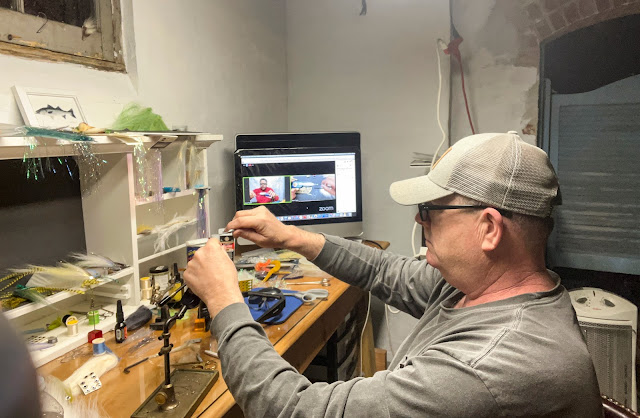
So after work I fired up my fly tying room computer and searched for his Hollow Fleye demo, HERE. My inital goal was to decifer and tie a Jim Matson fly but I don't have the correct tubing he uses, so I put that on the back burner for now. So I went forward and did what I thought I should do. I soon realized I may have two left hands as the finifshed products, I tried two, just don't seem to be correct, and I'll bypass giving JT credit, because these are not what he had in mind. What I realized
is the way to get good at this game is tie, practice, tie, practice and tie some more. That's why Jim had 1,000 flies in his basement. It's a process. Some things I learned....number one, don't run out of thread. I did and then had to search high and low for more fine mono to tie with. Thank goodness The Fly Fishing Show is jkust over a week away. Next, less is more, but sometimes
less is not enough. Look at the screenshot of the fly that JT had tied with lots of ostrich plume in there, far more than I tied in. And then there is the elusive correct taper, that's just practice. A mix of straight and reverse ties with ostrich and bucktail is what his flies call for. And then lastly, a fly isn't a fly right out of the vice. Things need to be tamed down and trained with some water, and a little swimming in real water, doesn't hurt, not that you should depend on that. And then eyes, he likes using jungle cock, but my shitty flies don't call for such an expensive ornament, yet. So today I'll look and see how much good and long my plumes are and I'll give it another go.
While searching, not stalking, for a JT tutorial I found that he will be at Tightlines Fly Fishing in Parsippany for a long day of tying on March 4th, 2023. The day is broken up into two parts. A fly tying class from 9-12, which has a $40 entrance fee, followed by a demo and presentation which is
free from 1-3pm. Tightlines has a solid lineup of fly tyers for their Saturday classes and David Nelson from Squimpish Flies will be there the following week on the 11th, same kind of day. It's a little over an hour drive for me from Titusville to Parsippany but it would be worth my time, and a good investment, to sign up, even though I will be in full fishing mode come March 1st. While you'll be able to see the flies tied in the picture that goes with the advertisement, you won't see that young lad, as that picture has some dust on it, just kidding Jason. But hey, look at the mess of a profile I'm sporting in the top photo. Getting old sucks. Time to do some of those old excercises the wrestlers used to do in high school to tighten things up as I hate having a turkey neck, which is coming along very nicely. Maybe instead of ordering a wading staff off of Amazon I should order the below set-up. I can do that while I sit there and botch up some more flies.
Just some cool stuff. First, I went and switched up the fly on The Average Angler logo. For nearly 15 years it has been a Royal Coachman, and now it's somehting more saltwaterish. I kinda of like the way it came out, few things I would tweak if possible. So after I drew it up I went to a
local embroidery shop to place an order. Over the years my first and only batch of hats have been lost (blowing off my head in the ocean), given away, taken by my wife, or damaged, ususally when the metal clip in the back rusts out. So just getting few hats done is not an easy, or affordable, thing.
Pretty much like anything else these days. It's $45 for the inital setup and then each hat, I went for the expensive Flex-Fit hats, with the embroidery is $35 each. Ouch! But I wanted to get the hats done. Why should I wear someone's elses hat? Once I got them home I could see the person that made them wasn't a fly fisherman, the cast is too straight, and not drawn like I did. The fly, whatever it is, doesn't have the hook showing from it, even just a little bit, which helps visullly identify it as a fly. And the logo is too big. I really like the original hats that I had done over 10 years ago. That guy was in Neptune, but has since went out of business. I may look him up rather than try and explain to my new people what I need.
And since this blog is about fishing, I guess now family, with a little Grateful Dead mixed in, how about this. This is the last year for the Dead & Co. going out on tour. Allegedly, that's it. No more. For the last few years they have been doing shows in Mexico calling it "Playing in the Sand". It's six days at an
all exclusive resort and three nights of shows with the band. They stay here and the stage is set up on the beach right there. All the food and drink you could want. As we speak Erin and Lauren are down there with my-ex, livng the life. When I asked Lauren if these shows were different, she explained it was like Deadhead's with money and that she preferred "the Shakedown grilled cheese crowd". This is crowd is older, a little more put together, and has a bit more money. I just took a look at tickets for the Philly show in June and they are $91.50 a piece. It's crazy what tickets for concerts cost these days, I can't imagine paying hundreds, or thousands to see Taylor Swift or Billy Joel.
And then there was this. What to do? Theresa and I took the dreaded drive out to Long Island to hook up with some of her grammar school buds. We went to a restaurant in a town called St. James on the North Shore. I don't know Long Island, but I did ask, are we near Gardiner's Bay or Montauk? Just in case I wanted to make a drive and needed a place to stay. It's about an hour and half away from them.
They treated us to a wonderful dinner and the menu was amazing. It was a menu that took me about 20 minutes to decide what I wanted. It was one of those farm to table local kinda places. On the menu, which I am not used to seeing living in New Jersey, was striped bass.....wild caught. I went back and forth. I haven't killed a striped bass in over 11 years....the commercials are ruining the fishery.....catch and release......all going through my head. And then I said really? So I was going to get something else, but I really wanted to try it. It isn't farm raised, it's probably from a nice 34-38" bass, probably caught here on Long Island......alright I did it, and glad that I did. It was delicious, and I
would order it again. While I was eating I couldn't help but think of the commercial side of the striped bass fishery. On Long Island seine net fishing was very popular and productive way to legally and commercially catch striped bass, the problem with that is, it help decimate migratory striped bass strocks. I am not sure if it is still allowed. While New York and other states have a commercial fishery New Jersey does not. What we do have is the Bonus Tag program that trasnferred our allotted commercial quota amount to the recreational side. In anything about anything related to money
there are going to be cheats, and in fishing we call them poachers. It happens in every fishery, both recreational and commercial. But it was, and still is, a big thing with striped bass. Anglers would be creepin' while your sleepin' and catch fish and bring them to the back door of the finest, and not so finest, restaurants, eliminating the reporting, and cutting into the quota, bypassing the "fees"
associated with fish mongers and places like the Fulton Fish Market, and having to report it as income and paying taxes on it. If you catch a 30 pound bass and the going market rate is $4 a pound and you sell it at the back door for $2, they save and you just made $60 to go fishing, and that's if you sell one fish. Jeff Nichol's, a Montauk Captain, and comedian, wrote a book, Caught, about this very same topic. It's a good read and eye opening at the same time.
And on this Martin Luther King Day I offer the above video in which legendary Bimini bonefish guide Ansil Saunders talks about having Dr. King out on his skiff just days before his assassination on April 4, 1968. I met Saunders and spent some time with him at his shed over a
decade ago while there visiting the Bimini Big Game Club. Inside he built and maintained his gear and skiffs. I didn't know of his interaction with Dr. King then but Simm's put out Mighty Waters last year. It's a good quick watch. I guess there's a little fisherman in all of us.
And there he is. The mad scientist. Nutty professor. All with respect and terms of endearment. You've probably seen that picture before. I went back into the hardrives to see what pics I had during a visit out to Jim's in 2013 that I never posted. It was then and there were I got my first glimpse of how an innovator works. Jim tied...a lot. He studied his flies, tweaked his flies, and swam
his flies. Then he repeated. He had more flies than I could count and he could ever fish. They were hanging, they were in fly boxes, and they were in bins. Before he passed in 2018 he hooked up a lot of people with materials, hooks, and flies. To return to the laboratory today there is presence you feel when enter that corner. An unfinished fly sits in the vice. There are some of the normal things you find at someone's tying station, and then there are things, plenty of them, that you just shake your head at after you pike them up. Many times I said to myself, "What in the hell did he do with that?"
Lets just pick one thing, airline tubing. He has some. He probably has enough to circle the earth. Now it's pretty much useless to another tyer, but if you decifer Jim's flies, it starts to make sense. And yesterday with Laura's blessing that's what I did. I picked a few off the wall and decoded them. I held materials back exposing the inner core. I searched in the bins to see how he stored the materials, then I would match them up and photograph them. These aren't your, well some actually are, your expensive display shadow box flies, like say those fancy salmon flies, these are utility flies. He tied them and tweaked them to make flies that catch fish. Isn't that the goal? So while the processes may be unorthodox to most tyers, I am learning how and why he did things. So let's look.
The above fly was most likley tied as a demonstration or process fly, a practice fly. A tad colorful for me, but I am sure a pike or other long fish might like to eat it. But looking inside I could see how he used tubing, wire, plastic balls, and cut plastic sheeting, the same material as the Pulse Disc, in it's design.
Below is the cut away from another fly, which will help me greatly as I work to duplicate it. First, like many other tyers do, I will sketch it out, then gather the materials, and then give it a go.
Interestingly, in Jim's mono extensions, he used a doubled over peice of mono on some of his flies. I will get into that later but it was interesting to discover, now I have to learn why. But what I do know is he secured it with a piece of tubing....lot's of tubing in this boys life. So before I said
good-bye to Laura I gathered some materials to try and duplicate it at home. I am going to try and tie it exactly as I see it, plastic balls and all, because, there must be a good reason why he has them in there. Earlier in the day while we caught up we couldn't help but talk about loved ones that pass
away, what we think, is way too soon. Ryan passed in 2017 and Jim 2018. That's four and five years, time does go quick when you think back, but if we keep the good memories and stories of them alive it helps to lessen the hurt that is always an underlying emotion.
So stay tuned as this little journey I'm going to take unfolds. I may just continue his same patterns, or as Jim would have loved, swim it, study it and make some notes, tweak it a bit, with solid reasoning of course, and then go fish it. And repeat, over and over again.
I've been doing a lot of tying and even more watching and following as well. One thing about today and anything that is anything to us is the realization that technology can be beneficial. Technology has done fly tying well. There are a ton of tutorials out there from some of the best tyers around the world. They are willing and eager to share their knowledge and skill with the rest of us.
As you know there are the big guns, the OG's, the originators and innovators who designed and developed the original patterns. Where would fly tying be today without, and I am sure I am leaving some out, Popovic's, Kreh, Clouser, Gartside, and Tabory (of Snake Fly fame)?
Over the years these orginal patterns have morphed into similair patterns, often without a true nod to the originators, that have become popular among tyers. Yes, things do evolve, from the patterns to the materials, like Squimpish, to the techniques. One could even say there are tyers out there who tie a better "Whatever" than the originator.
For me, and for the saltwater flies that I use, I have grown to admire and try to emulate things I have learned from locals like Farrar, Taylor, Stryker, and Warshauer. From outside the area we have seen tyers like Chocklet and Whalley rise in both popularity and talent. There's also Calcevechia and Cordiero who have developed a line of striped bass flies. A quick Google search and you can find a video of them tying up their specialities.
Again, that partial list is no slight to anyone I have missed, and in no disrespect to anyone else. When I see Ekelund tie, or get a handful of flies from Phiefer, see what Buzzi has at his show table, or see how effective Peterson's Ugly Ass Fly is, or see Devlin's big flies (in which he credits Sedotti) one can see there is a ton of local talent and innovation out there. And in regards to innovation, how could I forget Matson.
Over the last few years as technology has expanded our borders I have seen crazy talent from overseas. From Harvey to Van Wyk to someone I have just found, Paul Monaghan. His flies are beautiful, easily tied (to him), and are fish catchers. His videos are great, and I love his regular guy approach at the vice. He has a great dry sense of humor. You can see one of his videos below or find his You Tube channel HERE.
One thing is for sure some of todays fly tyers are pure artists. They spend a lot of time at the vice and a lot of time on each fly. Some of those Beast Fleye's take 1-2 hours apiece, and that is why they command upwards of $50 each. Between the cost of materials and the tyers time it's only fair, esepcially if they are doing it to make a living or side hussle.
Whalley
For the rest of us mortals fly tying is a means to an end. Making bait to go fishing. While the goal is to catch fish, sometimes, it really does matter what you tie on at the end of your leader. Flies that foul or swim wrong, although even those can catch fish, usually don't produce. Color, profile, size all matters, and then there's the presentation thing.
If you have some time do some Google searches of the names I posted above. Again, most have tutorials out there and are eager to share. In the end you still have to sit down and tie and get it done!
So why not some birthday walleye fishing? Well, it's not my birthday, but it is Theresa's so I thought I would celebrate it by going fishing. So my birthday was yesterday, and Theresa's is today, both Capricorns. And what does that mean? Could that explain why we get along like two peas in a pod, two bugs in a rug, or, at times, like oil and water? Interestingly, and I'm not sure why, but all of my four serious relationships in my life all were Capricorns. High school sweetheart of three years, both of us were Janaury 11th and same birth year, marriage #1, December 29th, second January 5th, and Theresa the 12th. So I looked online to see if there was one of those astrological explanations of two Caps coming together, is it something in the stars? Oh yeah, pic of the two of us above was taken at the Keswick Theatre in Pennsy last Saturday were she took me to see a RUSH cover band, YYNOT, that was my Christmas gift. See we're like besties....So let's see what they say about us.
So we have a lot of respect for each other, excited to make our dreams come true, and we "take a calm and practical approach to deal with any disagreements"..... And then further, "expect romantic dates where a limosine stands outside the gate....", squash, table tennis, swimming and jogging, and the best, "enjoying the wealth they accumulated". So on the flip side what do the stars say about the negative things when two Caps come together,
Well, ouch. I like the squash explanation better......anyway, Happy Birthday Theresa!
So back to fishing. Working from home today but with the mild weather I took a shot and went....walleye fishing. I've never walleye fished but did manage one this spring while doing the striped
bass thing. So off I went, looking for eddys and slower water where they may be laying. I hear it's a low and slow thing with a very subtle take, sounds kind of like a tog nibble, after almost not even stripping your fly in. So I fished for a bit, and then took a look at my fly, another Predator hook failure...just gone. For
kicks I went up to Lambertville and fished below the wing dam. Now walleye are more nocturnal eaters and I hear they perk up after their I think February spawning. It was fun, no takers, but at least I was fishing for a little over an hour. And now to the fly tying portion of the day. Last night Mike and I had
a hoot of a conversation about fly tying and Jim Matson. We talked about tying with mono extensions and reverse ties, and Hollow techniques, and then Mike mentioned Jim and his, of course, Nutty Professor way of fly tying. Years ago Jim gave me the below jig to tye up mono extensions. Mike couldn't believe that I had it. I've had it but it has sat on the side of my table for years. Like his boat, he's the only one who really understands it because he developed and used it. Well, Mike and I struggled through trying to remember how he laid in the bucktail, and then used some plastic tubing and then did this and that and soon it was done. Jim tied quickly, and developed things for him to tie more efficiently. So below is the jig. Tomorrow I am heading out to see Laura so I might wander down into the laboratory and see if there's anything else that goes with this invention. I can't wait.
Last year I lost so many flies in the jungle of the Delaware bottom I figured I better get some other than hook down done. So I used some big eyes that Leif gave me, glued on my new favorite eyes, and basically banged out a big Clouser, and 8 inch one. Feathers, SF Blend, Squimpish and bucktail all inside. It looks heavy but it's not. Last year I did good on the darker, black, white, tans, so I have to keep remembering to chose some darker colors, although, again, black bucktail is hard to find. With this weather we are having my mind is telling me the bass will be here soon. If I predict a first fish say March 20th, that's 68 days away......that's a long time.